 Polish Polar DataBase
Thermal structure of S Spitsbergen glaciers
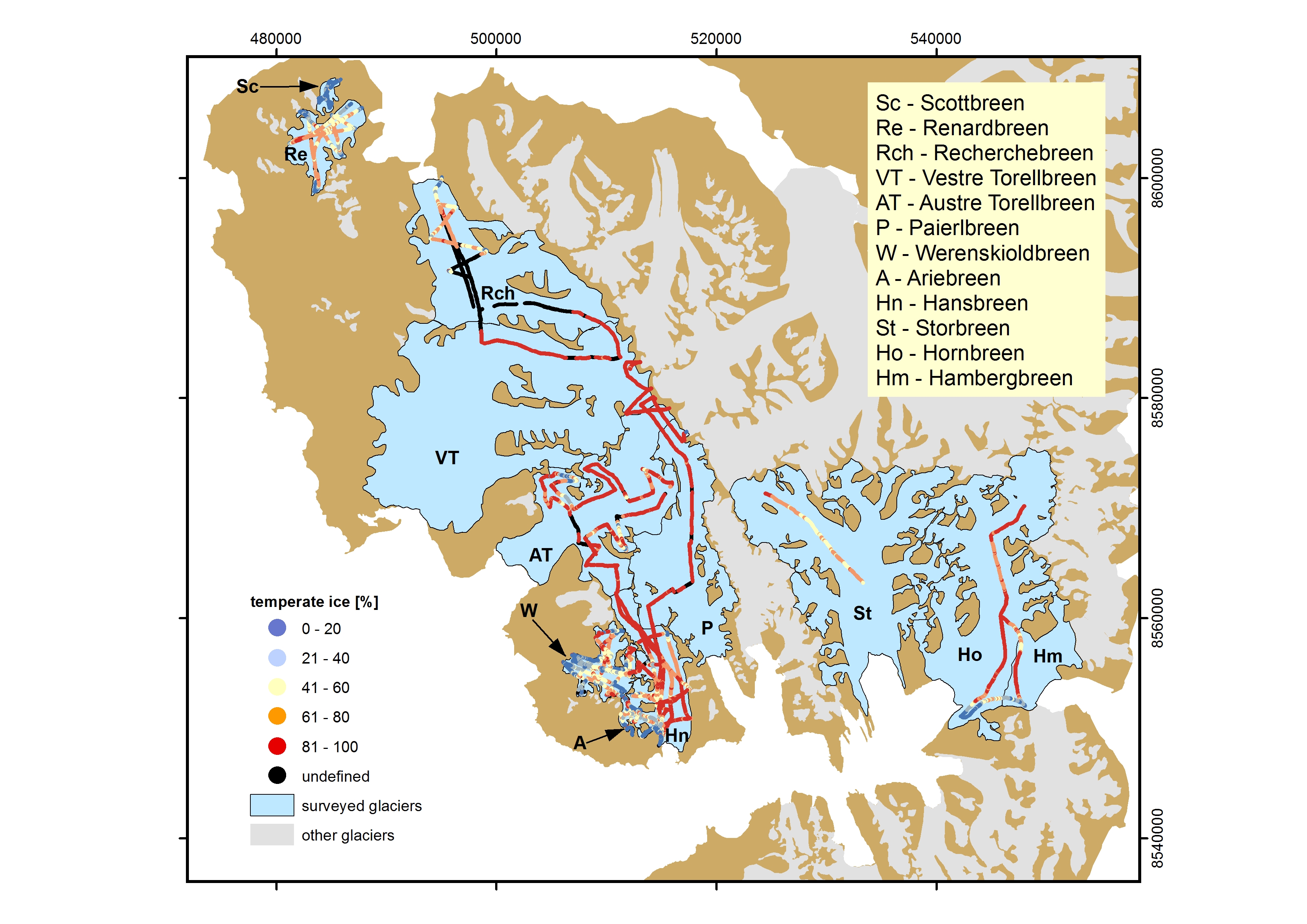
Thermal structure of selected S Spitsbergen glaciers was derived from ground based radio-echo sounding (RES). The division between cold and temperate ice layers is based on indirect interpretation of GPR (ground penetrating radar) image. Cold ice layer is virtually “transparent” for radio waves, while temperate ice layer is characterised by numerous diffractions on water inclusions.
The database contains results from 479.7 km of RES profiles acquired in 2007-2014 on 12 glaciers in Wedel Jarlsberg Land and Torell Land (S Spitsbergen) including: Amundsenisen, Austre Torellbreen, Vestre Torellbreen, Hansbreen, Storbreen, Hornbreen, Hambergbreen, Recherchebreen, Scottbreen, Renardbreen, Werenskioldbreen and Ariebreen. Basic characteristics of investigated glaciers and its thermal structure is provided in table 1 (supplementary information). The surveys used GPR antennas in range 25-200 MHz, selected according to expected ice depth. Thanks to that on 87% of the profiles ice/bed interface has been identified. The radar system was pulled behind the snowmobile moving with velocity c. 20 km h-1. Applying trace interval 0.2-1.0 s, trace-to-trace distance was in range 1-5m. Trace positions were acquired by GNSS receivers working in navigation or differential mode with respective accuracy 3.0 m and 0.1m. RES data were processed applying standard filtering procedure (DC-offset, time-zero adjustment, 2-D filter, amplitude correction and bandpass filtering). Time-to-depth conversion used average radio wave velocity (RWV) for glacier ice 16.4 cm ns-1, 16.7 and 16.1 for cold and temperate ice respectively, based on CMP survey. More precise description of data collection, processing and quality is provided by Grabiec (2017).
In S Spitsbergen polythermal glaciers are predominant. 57.8% of surveyed profiles consist of both: temperate and cold ice layers; 22.7% profiles is entirely temperate while 6.6% contains cold ice only (remaining profiles have undefined thermal structure). Studied glaciers represent broad spectrum of polythermal structure with cold-to-temperate ice ratio from 99:1% (Ariebreen) to 2:98% (accumulation zone of Vestre Torellbreen).
The data were collected and processed under following projects:
• IPY/269/2006 GLACIODYN The dynamic response of Arctic glaciers to global warming
• UE FP7-ENV-2008-1 ice2sea Estimating the future contribution of continental ice to sea-level rise
• PNRF-22-AI-1/07 AWAKE Arctic Climate and Environment of the Nordic Seas and the Svalbard – Greenland Area
• NCBiR/PolarCLIMATE-2009/2-1/2010 SvalGlac Sensitivity of Svalbard glaciers to climate change
• Pol-Nor/198675/17/2013 AWAKE-2 Arctic climate system study of ocean, sea ice and glaciers interactions in Svalbard area
• 03/KNOW2/2014 KNOW Leading National Research Centre
Reference:
Grabiec M. 2017: Stan i współczesne zmiany systemów lodowcowych południowego Spitsbergenu w świetle badań metodami radarowymi. Wydawnictwo Uniwersytetu Śląskiego, 328 s.
- Identification
- Distribution
- Quality
- Spatial rep.
- Ref. system
- Content
- Portrayal
- Metadata
- Md. constraints
- Md. maintenance
- Schema info
Identification
Data identification
Citation
- Date (Publication)
- 2020-12
- Purpose
- scientific and didactic
- Status
- On going
- Maintenance and update frequency
- Irregular
- Theme
-
- cold ice, temperate ice, thermal regime, GPR, RES
- Place
-
- Svalbard, Spitsbergen, High Arctic, Wedel Jarlsberg Land, Torell Land
Legal constraints
- Access constraints
- Copyright
- Use constraints
- Copyright
- Spatial representation type
- Vector
- Metadata language
- English
- Character set
- UTF8
- Topic category
-
- Geoscientific information
- Begin date
- 2008-01-01
- End date
- 2018-12-31
))
Distribution
Digital transfer options
- OnLine resource
-
Thermal structure of glaciers in Wedel Jarlsberg Land and Torell Land (S Spitsbergen)
(
WWW:DOWNLOAD-1.0-http--download
)
Dataset contains vector data of thermal structure of glaciers derived from RES.
Data attributes:
Id – defines glacier surveyed;
Northing, Easting – coordinates;
ti_ - percentage of temperate ice in the ice column
ci_m_pub – cold ice depth in 10 m intervals (eg. “20” means depth value in 11-20 m range, “30” means depth value in 21-30 m range) expressed in [m];
ti_m_pub – temperate ice depth in 10 m intervals (eg. “20” means depth value in 11-20 m range, “30” means depth value in 21-30 m range) expressed in [m].
For data in more accurate spatial (point-to-point distance) and vertical (specific depth of layers) resolution please contact mariusz.grabiec@us.edu.pl
- OnLine resource
-
The percentage of temperate ice after Grabiec (2017).
(
WWW:DOWNLOAD-1.0-http--download
)
Glacier basin outlines based on Żołna 2012 and Błaszczyk et al. 2013.
Błaszczyk M., Jania J.A., Kolondra L., 2013: Fluctuations of tidewater glaciers in Hornsund Fiord (Southern Svalbard) since the beginning of the 20th century. “Polish Polar Research”, Vol. 34, No. 4, s. 327—352.
Żołna G., 2012: Wykorzystanie teledetekcji oraz metod GIS dla zbadania wybranych cech lodowcow Spitsbergenu. Praca magisterska. Manuskrypt. Wydział Nauk o Ziemi, Uniwersytet Śląski w Katowicach, 75 s.
- OnLine resource
- Characteristics of thermal structure of glaciers along RES profiles (after Grabiec 2017) ( WWW:DOWNLOAD-1.0-http--download )
- OnLine resource
-
Extended human readable information about the dataset
(
WWW:LINK-1.0-http--link
)
Extended human readable information about the dataset
Quality
Data quality
- Hierarchy level
- Dataset
Ref. system
- Reference system identifier
- WGS84 UTM33X
Metadata
Metadata
- File identifier
- a1105d69-5ed1-43ce-a546-6dcf6f907778 XML
- Metadata language
- English
- Character set
- UTF8
- Date stamp
- 2020-12-09T11:47:14
- Metadata standard name
- ISO 19115:2003/19139
- Metadata standard version
- 1.0
Overviews
Spatial extent
Provided by
